


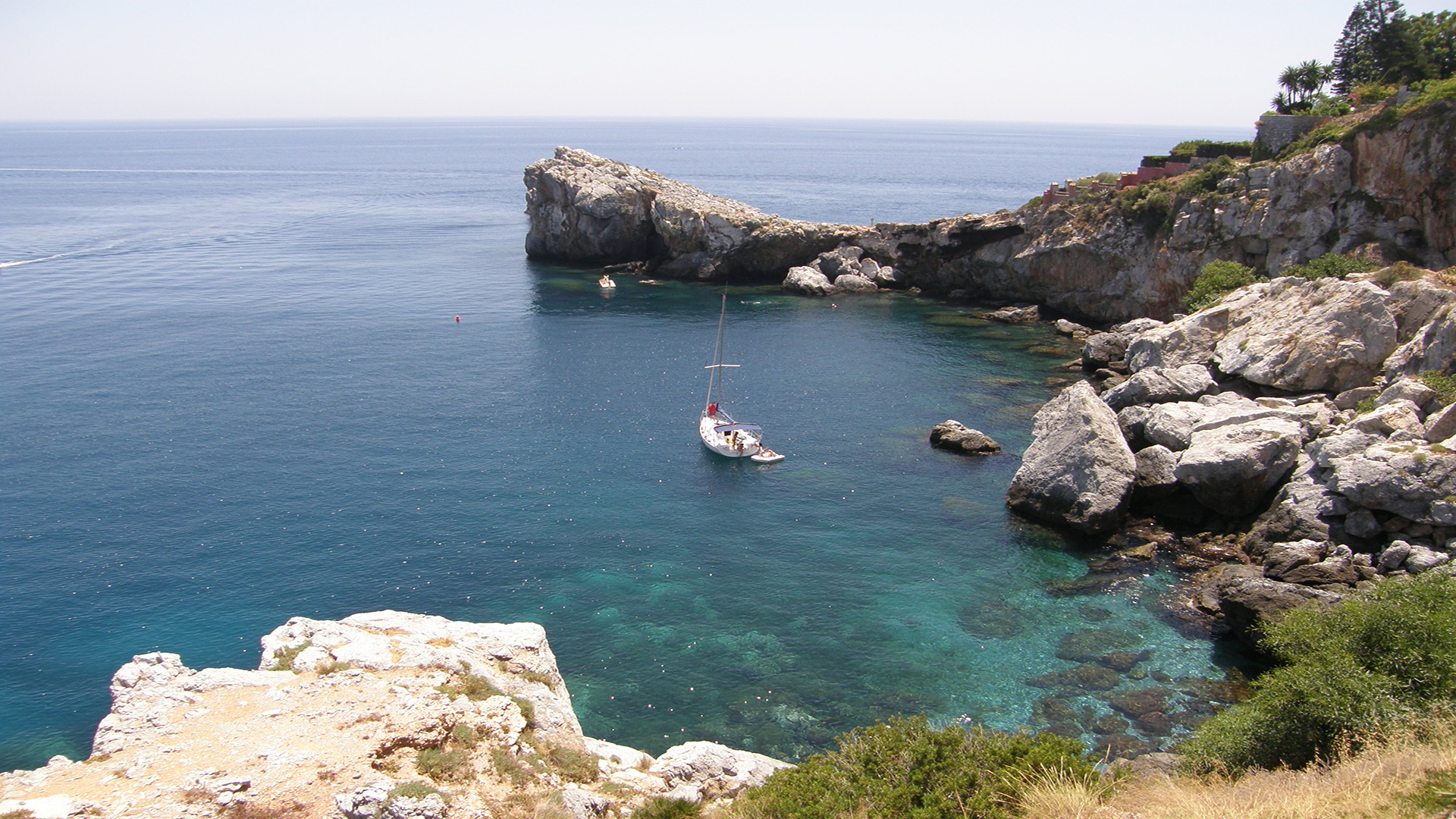
Hay pueblos de costa que se visitan y pueblos de costa que se viven. La Herradura es de los segundos. Su bahía, cerrada por la Punta de lSome coastal towns are places you visit. La Herradura is a place you live in for a few days. Its bay, closed off by Punta de la Mona on one side and Cerro Gordo on the other, curves into an almost perfect horseshoe — hence the name — and has turned this corner of Almuñécar into the diving and watersports capital of the whole province of Granada. You don’t come here to queue for a monument. You come to get in the water, walk the cliffs and eat sardines grilled on an open fire with your feet on the shingle.
That’s the key to this guide. If you’re looking for things to do in La Herradura, the answer isn’t a list of museums — it’s a handful of very specific plans that sort themselves out depending on how much time you have and how keen you are to get wet. We’ll run through all of them, and we’ll deal with the logistics at the end: how to get here from Málaga Airport, how to move around the area and what to watch out for if you’re travelling without a car.
Where La Herradura is, and why it’s worth your time
La Herradura is a village within the municipality of Almuñécar, on Granada’s Costa Tropical, about 8 kilometres from the centre of Almuñécar in the direction of Málaga and barely 4 kilometres from the provincial boundary. It’s the municipality’s second-largest settlement and it has a life of its own: its own seafront promenade, its own beach bars, its own dive centres and its own marina.
What sets it apart from other towns along this coast is the geography. To the west, the Maro-Cerro Gordo Cliffs Natural Area, protected since 1989, with around 400 hectares of land and a wide protected marine strip. To the east, Punta de la Mona, a headland of pine trees and white villas hiding the finest seabed on the eastern Andalusian coast. In between, a bay sheltered from the westerly wind, where the sea is often flat calm while Nerja is already getting waves.
If you want the wider picture of the area, our blog also has a guide to what to see in Almuñécar, the town La Herradura belongs to.
The best things to do in the water
1. Dive at Punta de la Mona, the best seabed in Granada
If La Herradura is known for one thing outside Andalusia, it’s diving. The waters around Punta de la Mona are designated a Special Area of Conservation, and the mix of vertical walls, caves and posidonia meadows supports a biodiversity that’s hard to match anywhere in the Spanish Mediterranean: around 250 marine species are recorded on these dive sites.
The dive sites are well mapped and there’s something for every certification level:
- Punta de la Mona (down to 48 m): the headline dive, for Advanced divers.
- Piedra de La Higuera (to 22 m): crevices full of life and the odd submerged wreck.
- Punta del Vapor (to 18 m) and Roqueo de los 14 (to 14 m): ideal if you’ve just earned your Open Water.
- La Playita (to 11 m) and La Calita (to 36 m), both inside the bay itself.
- Los Candelabros and La Pared Amarilla, over on the Maro-Cerro Gordo side.
There are several PADI centres in the village running daily trips. If you’ve never dived before, a try dive here is one of the best first times you can have in Spain.
2. Take a kayak and snorkel trip along the cliffs
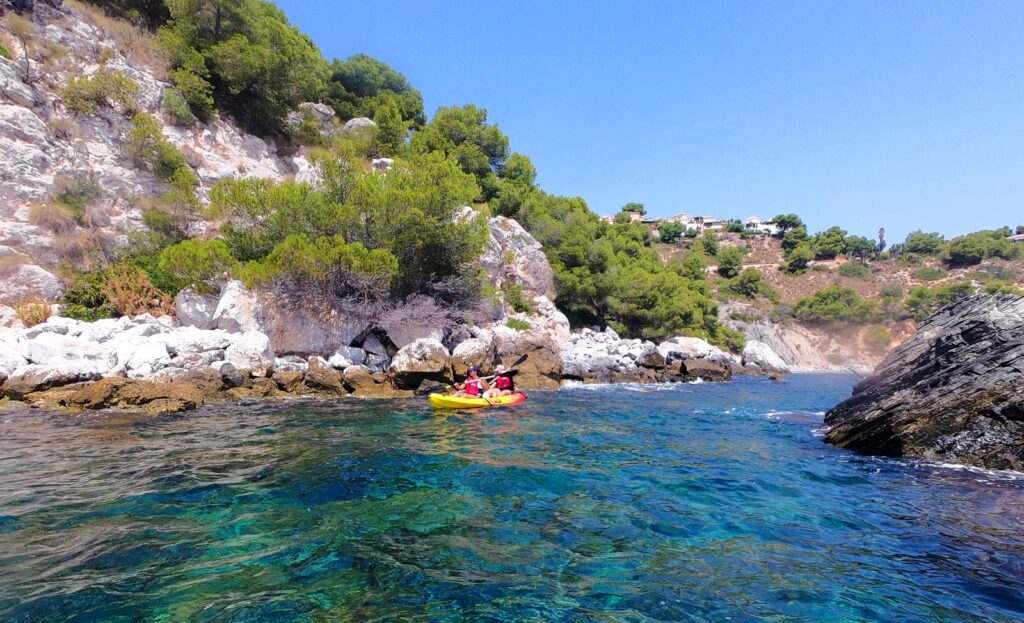
The most photogenic plan in La Herradura and, in all likelihood, the one people repeat most. Guided routes of around two hours set off from the main beach, hug the coast towards the natural area, slip into sea caves — the Cueva de las Palomas can only be reached from the water — and stop for a snorkel over a protected stretch of seabed.
You can also hire a kayak and go it alone if you have some experience. One tip: go early. A breeze usually picks up around midday, and paddling back into a headwind stops being fun surprisingly fast.
3. Paddleboarding, windsurfing and sailing in the bay
La Herradura’s bay has been a playground for dinghy sailors and windsurfers for decades, precisely because it’s so sheltered. There are schools and hire points on the beach itself — paddleboards and kayaks — and more at the marina. It’s a forgiving place to learn: flat water in the mornings and a predictable thermal breeze in the afternoons.
The beaches and coves, one by one
4. Playa de La Herradura
The town beach: long, shingle and pebble, with the whole village turned towards the promenade. It has full facilities and a row of beach bars where grilled sardine skewers are practically a religion. It’s the easy choice if you’re with kids or you just want a straightforward day by the sea.
5. La Playilla and Marina del Este beach
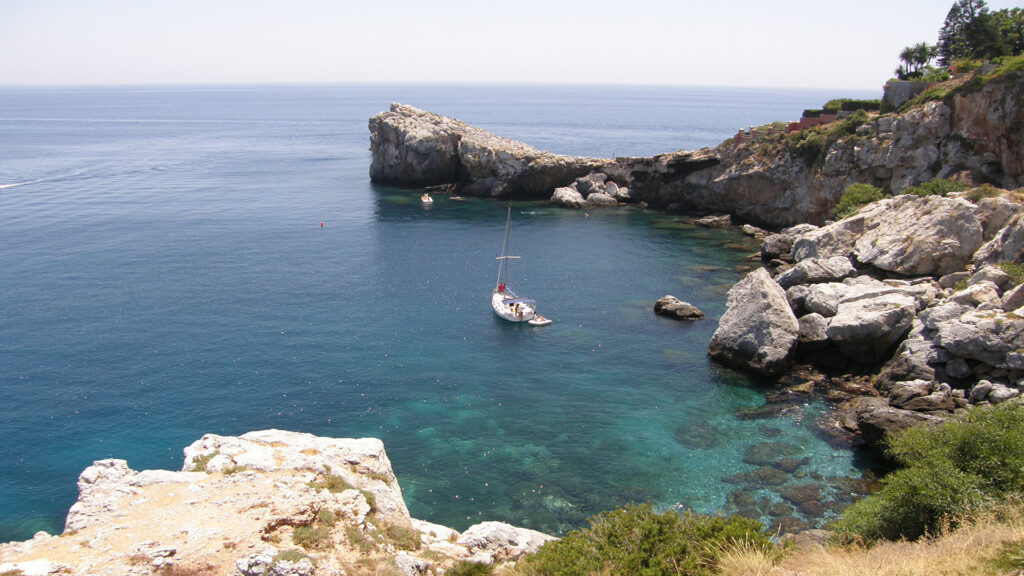
Two small, sheltered coves next to Punta de la Mona. The one at Marina del Este, roughly 250 metres long, sits right by the marina and tends to have unusually clear water — which makes it an excellent spot for snorkelling without needing a boat.
6. Playa de La Calaiza
A pebble beach west of the village, quieter and with fewer facilities than the main one. Perfect if you’re after space in August and don’t mind bringing your own cool box.
7. Cantarriján cove — the gem, with the small print
This is the most spectacular cove in the area, wedged between the cliffs, with a long-standing naturist tradition — though clothed and unclothed bathers share the sand without any fuss. There are a couple of beach bars and an atmosphere you won’t find elsewhere.
The small print matters here: between 1 June and 30 September the access road down to the cove is closed to private vehicles to protect the natural area. During those months you get there on the shuttle minibus from the upper car park — around €3 return, with departures roughly every 15 minutes between 9:00 and 21:00 — or on foot, down 1.4 kilometres of steep track. Check the current timetable and fare before you go, as they change each season.
What to see on land: the castle, the towers and the viewpoints
8. La Herradura Castle and “The Fury of the Sea”
Just behind the beach stands the castle, built in 1764 as part of the coast’s defences. Today it houses the “1562. La Furia del Mar” interpretation centre, devoted to one of the most dramatic episodes in Spanish naval history: the wreck of Juan de Mendoza’s fleet in this very bay. It’s a short, inexpensive visit with far more substance than you’d expect.
Check opening hours and admission prices before you go, as they vary by season.
9. The Punta de la Mona lighthouse and the Chapel of San José and Santa Rita
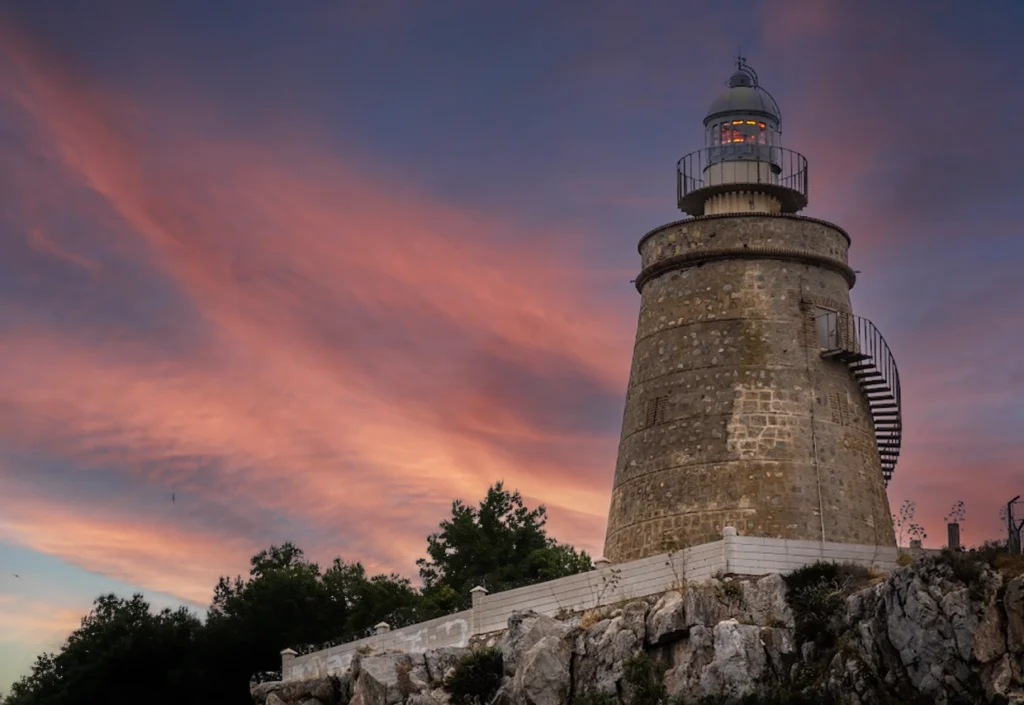
Walking up to Punta de la Mona is the classic thing to do at sunset. The lighthouse tower is Nasrid in origin and was refurbished in 1990; from the surrounding area you get a panorama taking in the entire bay and, on a clear day, a good stretch of coast towards Nerja.
Muy cerca, sobre Marina del Este, la pequeña Ermita de San José y Santa Rita ofrece una de las mejores vistas de toda la Costa TNearby, above Marina del Este, the small Chapel of San José and Santa Rita offers one of the finest views on the whole Costa Tropical. In summer there are evening masses.
10. The Cerro Gordo watchtower
Sixteenth-century, at the opposite end of the bay, part of the chain of watchtowers that once guarded this coast against Barbary pirates. You can drive most of the way and walk the last short stretch. The viewpoint is, without question, the best sunset spot in the area.
11. Hiking the Maro-Cerro Gordo Cliffs
The natural area separating La Herradura from Nerja is one of the best-preserved stretches of undeveloped coastline in the peninsular Mediterranean, and you can walk it. The most popular route links the Cerro Gordo viewpoint with the beaches of Cantarriján and El Cañuelo, along paths threading between agaves and pine woods, with repeated descents down to the water.
Three warnings worth taking seriously: there’s very little shade, the climb hurts more on the way back than on the way out, and in summer the sensible move is to set off very early or leave it until late afternoon. Take plenty of water and shoes with proper grip.
If this is your kind of plan, Maro and its coves sit at the far end of the same natural area, and a little further inland you’ll find the prettiest villages near Nerja.
12. Marina del Este: the marina, boat trips and sunsets
Tucked between mountains, the Marina del Este yacht harbour is one of those postcards you don’t expect to find in Granada. It has berths, sailing schools, dive shops, boat hire and a row of restaurants with terraces over the water. It’s where you go for dinner when you want the evening to feel like more than it cost.
Boat trips also leave from here for dolphin watching and coastal excursions towards the cliffs.
Where and what to eat in La Herradura
The cooking here is pure Costa Tropical: fried fish, sardines grilled on skewers over an open fire on the sand, anchovies, baby squid and prawns from Motril. The beach bars along the promenade are the safe bet at lunchtime; Marina del Este is the one for dinner.
Don’t leave without trying the region’s subtropical fruit — custard apple, avocado and mango all grow a few kilometres away, on the slopes around Almuñécar and Jete — and without sitting on a terrace on the promenade at the hour when the sun drops behind Cerro Gordo.
Which plan suits your trip
| If you’re travelling… | The plan | Time needed |
| With children | Playa de La Herradura + the castle | Half a day |
| As a couple | Cerro Gordo tower at sunset + dinner at Marina del Este | An afternoon |
| Looking for adventure | Diving at Punta de la Mona or kayaking to the caves | 3–4 hours |
| To switch off | Cantarriján or La Calaiza | A full day |
| To walk | Cerro Gordo – Cantarriján – El Cañuelo trail | Half a day |
| Passing through, no car | Promenade, castle and Marina del Este | 2–3 hours |
When to visit La Herradura
- Spring (April–June): the best time for hiking and for the season’s first dives. Fewer people, comfortable temperatures and the natural area at its best.
- Summer (July–August): street life, festivals and the sea at its warmest. Watch out for the restricted access to Cantarriján and for parking in the village, which fills up. The Virgen del Carmen festivities, around 16 July, include a maritime procession and are the best moment to see the village at its most authentic.
- Autumn (September–October): for many people, the ideal season. The water is still warm, underwater visibility improves and the beaches empty out.
- Winter: mild weather and superb light. This is when the plan shifts towards viewpoints, trails and long lunches.
Getting to La Herradura and getting around
This is the part that ruins the most trips, so let’s be specific.
From Málaga Airport, La Herradura is about 80 kilometres away on the A-7, a little under an hour in normal conditions. Public transport is more awkward: there is a bus, but with very few departures a day and connections involved, and the journey stretches past an hour and a half before you add the walk to your accommodation with luggage.
That’s why the option that works best for most travellers is a private transfer from Málaga Airport to La Herradura: you’re met at the terminal, dropped at the door of your apartment or hotel, and the price is fixed from the outset — no surprises for traffic or luggage. Telecabbie runs the service in Mercedes vehicles, with complimentary drinks and 24-hour availability.
For getting around the area, La Herradura works as an excellent base:
- Almuñécar, 8 km away, with San Miguel Castle and El Majuelo park: book a taxi to Almuñécar.
- Maro and its cave, on the far side of the natural area: transfer to Maro.
- Nerja, about 20 minutes away, with the Balcón de Europa as the essential stop: taxi to Nerja. Before you go, have a look at our guide to what to see in Nerja.
- Motril and the rest of the Costa Tropical, heading east: transfer to Motril.
- Granada city and the Alhambra, just over an hour away on the A-44: Málaga Airport – Granada taxi.
You can see all the areas and services we cover and organise every journey of your trip in one go.